Transformational Game Design
Course Work
Skills: Rapid Prototyping; Player Testing; Team Work
Overview
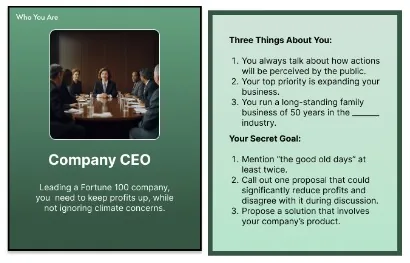
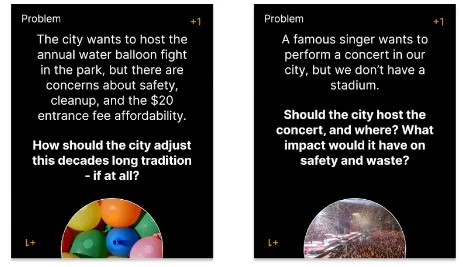
This class was part of Carnegie Mellon’s Center for Transformational Play. The focus of this class was on the design of physical games and the fundamentals of designing under time constraints. Each design cycle lasted about 2 weeks, from initial idea creation to final prototype. We created physical games, such as card games. Since the games were transformational, it was important to consider who the sponsor was and what they wanted the players to take from the experience of playing the game. Each project was extremely different from the last, in terms of sponsor need and user demographics. We also worked in pairs and teams to understand the challenges that arise from designing as a group and how to overcome those constraints. We needed to understand how to leverage everyone’s experiences and knowledge to build something better. The photos included here are part of a game focused on helping students to figure out what they want to do after school. The game functions by asking each player to imagine themselves in a different position and how they would respond to potential problems. Players then rate each others’ responses based on creativity or humor, depending on what the judge decides.
Design Process
Each game design iteration was broken into three distinct parts: brainstorming, prototyping, and testing.
Brainstorming: This stage of the process included speaking to the sponsors and understanding what they needed. The class would ask questions to understand the problem space and what kind of transformation was desired. We would then use this information to brainstorm using processes such as crazy-8s, mind maps, and storyboarding.
Prototyping: During this stage we created prototypes of different fidelities, often focusing on the functionality of the game rather than the aesthetics. Since we were creating transformational games, it was important to understand if the mechanics worked as intended and if the players gained anything from the experience. This stage of the process was often revisited, with most projects needing 3 prototypes.
Testing: To test our games we used a specific process used in the Center for Transformational Play called EOTA. This uses experiences from players (E); observations made by the creator or other participants (O); theories about why something happened (T); and advice from the participants and other observers (A). This testing process allowed us to understand what was happening and why it was happening, but the play testers always knew that they were experiencing an incomplete game. Including the advice from the play testers allowed me to understand where they thought the experience lacked and what they would expect from a game.